Mandatory Source Segregation – Poor Enforcement
Get It Now !

Executive Synopsis
In contrast to linear "take-make-dispose" systems, the circular economy concept prioritizes sustainability, regeneration, and reuse. In India's cities and rural areas, organic waste—especially food and biodegradable waste—offers a significant chance to apply circular solutions. Waste is now a useful input rather than a burden thanks to the development of sophisticated composting technologies like high-capacity OWC machines, automatic composters, and smart digesters.
This case study lists the top five ways that cutting-edge composting technology advances the circular economy by transforming urban waste ecosystems and closing the loop on organic waste.
1. Producing Superior Organic Compost from Biodegradable Waste
Modern composting machines turn food and garden waste into nutrient-rich organic compost by shredding, controlling moisture, and speeding up microbial processes.
Benefits
- restores the fertility and health of the soil
- takes the place of chemical fertilizers
- improves agricultural water retention
Table 1: Nutrient Content of Compost from Different Waste Types
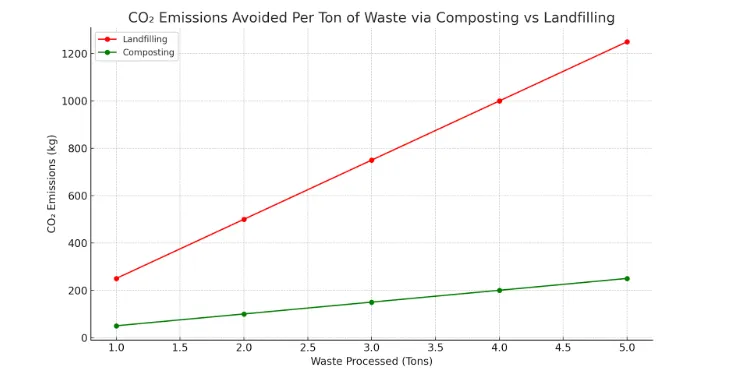
2. Reducing Emissions and Dependency on Landfills
Landfills in India are overflowing. The amount of waste that is transported and disposed of is greatly decreased by composting at the source
.
Large-Scale Composting Units' Effect:
- keeps methane (CH₄) emissions at bay.
- lowers the amount of diesel used in waste transportation
- keeps groundwater from becoming contaminated by leachate
Graph 1: CO₂ Emissions Avoided Per Ton of Waste via Composting vs Landfilling
3. Enabling Urban Decentralized Composting Models
Decentralized waste processing is feasible thanks to sophisticated composting equipment. Composting hubs are now positioned in place of central landfills in:
- Residential communities
- Wards within municipalities
- Clusters of smart cities
- Office buildings
For example:
In Pune, a 500 kg/day OWC machine processes waste from five housing societies and generates 120 kg of compost every day, which is sold locally and used for rooftop farming.
Table 2: Performance of Smart Composting Units (Sample Deployments)
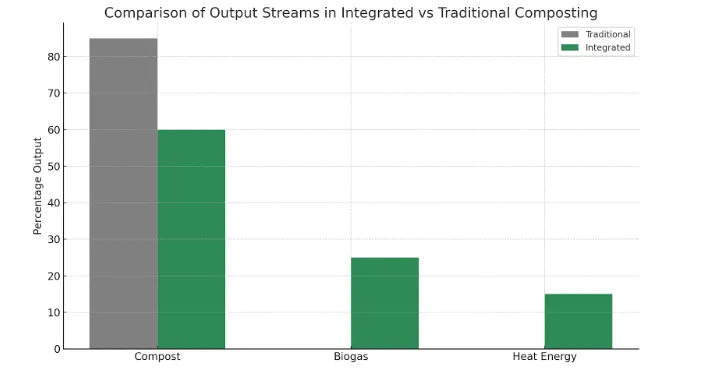
4. Connecting to Nutrient Recovery and Waste-to-Energy Systems
These days, some sophisticated composters collaborate with:
- Bio-digesters: for recovering biogas and slurry
- Dehydrators: to lower the amount of pre-composting
- IoT monitors: for tracking output in real time
- Both the waste-to-energy and waste-to-compost pathways are supported by this integrated approach.
Graph 2: Comparison of Output Streams in Integrated Composting vs Traditional Composting
5. Facilitating Green Entrepreneurship in Communities
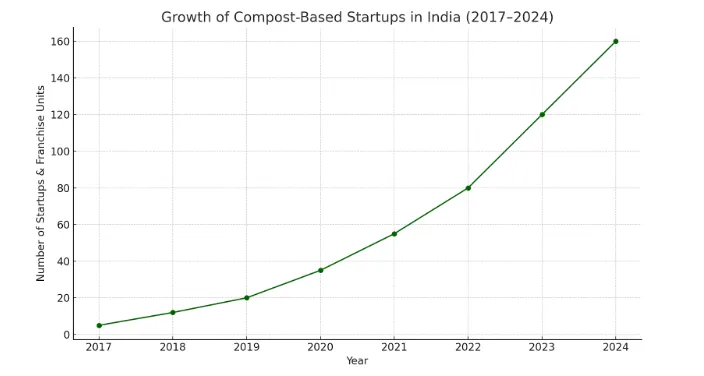
Models for circular composting create new sources of income:
- Packaging and retailing of compost
- Leasing services for OWC machines
- Product development using compost (soil blends, grow bags)
- Local franchises that compost
These models encourage waste-based entrepreneurship among startups, women, and young people while also generating green jobs.
Graph 3: Growth of Compost-Based Startups in India (2017–2024)
In conclusion
Cutting-edge composting technologies are catalysts for regenerative, circular systems that increase sustainability, lower emissions, and add value to communities. They are more than just waste management tools. These systems allow for self-sufficient urban ecosystems by diverting organic waste from landfills and turning it into energy and usable compost.
With its IoT-enabled composting solutions, modular biodigesters, and high-efficiency OWC machines, Waste is Gold Technologies is still at the forefront of helping India make the shift to a circular economy.